Mahsa Jina Amini and Anne Frank: Woman, Life, Freedom

Speech delivered on November 30, 2022, at TU Delft, as part of the Campus Rally for Iran, in which scholars from 227 universities across the world demonstrated for freedom, justice, and democracy in Iran.


Dear Friends, Salām!

Thank you for the invitation to speak here, which is an honor. My name is Arie, Arie van Deursen. I am a professor in computer science, and I am head of one of the Computer Science Departments here at TU Delft.

Computer science, like many other academic disciplines, is highly international. For example, when I saw the list of 135 universities participating in today’s rally, I recognized many places. I visited or collaborated with scholars from UBC, UVic, Waterloo, Amherst, UC Davis, Stuttgart, Bremen, Milan, Utrecht, and many more.

The reason is that academia is united as one. As academics, we believe in the free, rational exchange of ideas, to make this world a better place. Such discussion does not take place in isolation, but happens together, among academics from all over the world. Scholars depend on each other. We need each other. This also means that

  • If academia in one country is suffering, all of academia is suffering;
  • If students and professors are assaulted or arrested at one university, all universities feel the pain;
  • If, as in Iran right now, academic women, life, and freedom are under attack, all of academia is under attack.

This is why we stand here today, as scholars from all over the world, in solidarity with the students and scholars in Iran, in their peaceful fight for the freedom of the people of Iran.

I also stand here as a head of department. Like the rest of academia, the employees of my department, and the students we educate, come from all over the world. These include dozens of incredibly talented and wonderful people from Iran, many of whom are here today.

I cannot begin to imagine how difficult this period must be for you. You must be deeply concerned about the lives of your loved ones in Iran and the fate of your country. We, your colleagues, your peers, your professors: We think of you and we support you, and we strongly condemn the violence against you. If there is anything we can do to help you, please let us know.

I personally began to understand the situation in Iran a little better when I started supervising a PhD student from Iran, back in 2005. (Since then I have worked with many, and they have all been marvelous). This first student (Ali Mesbah, now a professor at UBC), defended his thesis in June 2009. As you know, this was an eventful period in Iran, and he, his paranimphs, and many people in the audience wore green wristbands in support of the protests in Iran at that time.

A few years later I read Marjane Satrapi’s beautiful graphic novel Persepolis. I think the book is forbidden in Iran, but my then teenage children had to read it at high school in The Netherlands, which prompted me to read it as well. I was mind blown. Persepolis tells Satrapi’s story of growing up in the new Islamic Republic: The oppression, the violence, and the balancing act separating your secret private life from what is allowed in public. It is also a story about moving to Europe as an art student, the loneliness this brings, and about how much you can miss your home country. And it is, ultimately, a story about love and family.

In a Vogue interview in 2016 with Emma Watson (of Hermione Granger fame), Marjane Satrapi gave a clear diagnosis of the root cause of Iran’s current status: “The enemy of democracy isn’t one person. The enemy of democracy is patriarchal culture.”

For resisting that culture, for fighting the patriarchy, Mahsa Jina Amini paid the ultimate price.

Since then, women and men across Iran have followed her lead, demanding freedom. Hundreds of peaceful protesters have been killed, thousands arrested, and tens of thousands assaulted. Despite that, the struggle for freedom continues. An iconic picture to me is that of two young women, no hijab, who were simply offering free hugs in a street in the city of Kermanshah. This is a time when the sad people of Iran just need a hug, they observed.

They were risking their lives. Their bravery is an inspiration to all of us.

Therefore, we stand here, and in more than one hundred universities around the world, in strong solidarity with you, to support you, in your demand for justice and freedom.

Let me conclude with a quote from another strong young woman, Anne Frank. She wrote it in her diary on April 12, 1944, when she was 14 years old. She had spent two years in an attic in Amsterdam, hiding for the German Nazi occupiers of The Netherlands. The day before, their hideout had been discovered by a burglar. They weren’t arrested yet, but the danger was imminent.

This is what she wrote. I’ll read it first in Dutch, and then in English.

Ik weet wat ik wil,
ik heb een doel; een mening,
ik heb een geloof en een liefde.
Laat me mezelf zijn, dan ben ik tevreden.
Ik weet dat ik een vrouw ben,
een vrouw met innerlijke sterkte en veel moed.

I know what I want,
I have a goal, an opinion,
I have a religion and love.
Let me be myself and then I am satisfied.
I know that I am a woman,
a woman with inward strength and plenty of courage.

Woman — life — freedom
Jin — Jiyan — Azadî
Jin — Jiyan — Azadî

Thank you very much!


Arie van Deursen. Delft, November 30, 2022

Member Advisory Council IT Assessment

July 15, 2022, I have been appointed by the cabinet of the Dutch government as a member of the Advisory Council IT Assessment (AcICT), starting September 1st, 2022. I am happy, and honored, with this appointment!

The task of the council is as follows (my own translation):

The Advisory Council IT Assessment judges risks and the chance of success of ICT (Information and Communication Technology) projects within the Dutch national government, and offers advice for improvement. It also assesses the effectiveness and efficiency of the maintenance and management of information systems. The council consists of experts, from academia and industry, who have administrative, supervisory and management experience with regard to the realization, deployment and control of ICT processes.

Ministeries submit any project with an ICT-component of over 5 million Euros to the council. Based on a risk assessment, the council subsequently decides whether it conducts an investigation.

Since 2015, almost 100 assessments have been conducted, on various domains. Recent examples include high school exams, governmental treasury banking, vehicle taxes, and the development process of the Dutch Covid-19 tracking app.

The resulting assessment reports are 7-8 pages long, centered around a number (typically three) of core risks, followed by specific recommendations (also often three) on how to address these risks. Example risks from recent reports include:

  • “Key project results are not yet complete in the final stages of the project” (treasury)
  • “An unnecessarily fine-grained solution takes too much time” (exams)
  • “The program needs to realize too many changes simultaneously” (vehicle taxes)

The corresponding recommendations:

  1. “Work towards a fallback scenario so that the old system can remain in operation until the new system is demonstrably stable” (treasury)
  2. “Establish how to simplify the solution” (exams)
  3. “Reduce the scope” (vehicle taxes)

The assessments are prepared by a team of presently around 20 ICT researchers and research managers. When needed, external researchers with specific expertise are consulted. Assessments follow an assessment framework, which distinguishes nine risk areas (such as scope, architecture, implementation, and acceptance).

The assessments serve to support political decision making, and are focused on the Dutch parliament and ministers. For each assessment, the minister in question offers a formal reaction, also available from the council’s web site. This serves to help parliament to fullfil their responsibility of checking the executive ministers.

The council consists of five members, each involved part time (for one day per week), for a period of four years, each bringing their own dedicated expertise. For me personally, I see a strong connection with my research and education at the TU Delft, in such areas as software architecture, software testing, and developer productivity.

As a computer scientist, I consider responsible, transparent, and cost-effective digitalization of great importance for the (Dutch) democracy and society. The advisory council fulfills a unique and important role, which is closely connected to my interests in software engineering. I look forward, together with my new colleagues from the AcICT, to contributing to the improvement of the digitalizations of the Dutch government.

I am presently not aware of comparable councils in other countries, in Europe or elsewhere. If you know of similar institutions in your own country, please let me know!

Lid Adviescollege ICT-toetsing

Op 15 juli 2022 ben ik door de ministerraad benoemd als lid van het Adviescollege ICT-toetsing (AcICT), op voorstel van staatssecretaris Van Huffelen van Koninkrijksrelaties en Digitalisering, per 1 september 2022. Ik ben blij en vereerd met deze benoeming!

De opdracht van dit college is:

Het Adviescollege ICT-toetsing oordeelt over de risico’s en de slaagkans van ICT (Informatie- en Communicatie Technologie) projecten binnen de Rijksoverheid en geeft adviezen ter verbetering. Ook toetst het de doeltreffendheid en doelmatigheid van onderhoud en beheer van informatiesystemen. Het adviescollege bestaat uit deskundigen – uit de wetenschappelijke wereld en het bedrijfsleven – die beschikken over bestuurlijke, toezichthoudende en managementervaring met betrekking tot realisatie, inzet en beheersing van ICT-trajecten.

Ministeries melden elk project met een ICT-component van meer dan 5 miljoen Euro bij het Adviescollege aan. Op basis van een risicoanalyse beslist het AcICT vervolgens of het een onderzoek uitvoert.

Sinds 2015 (toen nog als Bureau ICT-toetsing — BIT) zijn bijna honderd onderzoeken uitgevoerd, recent bijvoorbeeld over het moderniseren van examens, het digitaliseren van schatkistbankieren, het rationaliseren van de motorrijtuigenbelasting, en het ontwikkelproces van de Coronamelder app.

De meeste adviezen zijn 7-8 pagina’s in omvang, en zijn opgebouwd rond een kern van (vaak drie) belangrijke risico’s, gevolgd door enkele (ook vaak drie) concrete adviezen hoe de koers bij te stellen in het licht van deze risico’s. Genoemde risico’s zijn bijvoorbeeld:

  1. "Cruciale projectresultaten nog niet gereed zijn in het eindstadium van het project" (Schatkistbankieren)
  2. "Onnodig fijnmazige oplossing kost veel tijd" (Examens)
  3. "Het programma moet te veel veranderingen tegelijk realiseren" (Motorrijtuigenbelasting)

Met bijbehorend advies:

  1. "Werk een terugvalscenario uit zodat het oude systeem blijft functioneren totdat het nieuwe systeem aantoonbaar stabiel is." (Schatkistbankieren)
  2. "Identificeer hoe de oplossing eenvoudiger kan" (Examens)
  3. "Beperk de scope" (Motorrijtuigenbelasting)

De adviezen worden voorbereid door een team van (op dit moment) circa 20 ICT-onderzoekers en -onderzoeksmanagers. Waar nodig worden ook externe onderzoekers met specifieke expertise ingezet. Leidraad voor elk onderzoek is het toetskader, waarin negen risicogebieden (zoals bijv. scope, architectuur, realisatie, en acceptatie) worden onderscheiden.

De adviezen dienen ter ondersteuning van de politieke besluitvorming, en zijn dus gericht op de Eerste en Tweede Kamer en de ministers en staatssecretarissen. De minister reageert op het onderzoek van het AcICT middels een brief die ook openbaar is (en ook te vinden op de AcICT website), waarna het parlement de adviezen en de bestuurlijke reactie kan controleren.

Het Adviescollege zelf telt vijf leden, elk met hun eigen expertise, die dit werk in deeltijd doen (één dag per week), voor een periode van vier jaar. Voor mij zie ik een mooie aansluiting bij mijn onderzoek en onderwijs aan de TU Delft, bijvoorbeeld op het gebied van software-architectuur, software-testen, en efficiëntie van het software-ontwikkelproces.

Verantwoorde, transparante, en kosten-effectieve digitalisering is van groot belang voor de Nederlandse democratie en samenleving. In het realiseren hiervan speelt het Adviescollege een belangrijke rol, en ik wil me dus graag inzetten voor het AcICT.

Ik zie ook een mooie connectie tussen de taken van het Adviescollege en mijn eigen kennis en ervaring op het gebied van software engineering. Ik kijk er naar uit om, samen met de nieuwe collega’s van het AcICT, een bijdrage te leveren aan de succesvolle digitalisering van de Nederlandse overheid.

TU Delft Computer Science Research Assessment 2015-2020

Last year, the TU Delft computer science research programs were evaluated, comprising a reflection on the preceding six years (2015-2020), and an outlook the next six years.

The assessment follows the Strategy Evaluation Protocol (SEP), used by all Dutch universities, which focuses on research quality, societal impact, and viability. The assessment is conducted by an international external committee. It is based on a self-assessment written by us, as well as a two-day site visit by the committee.

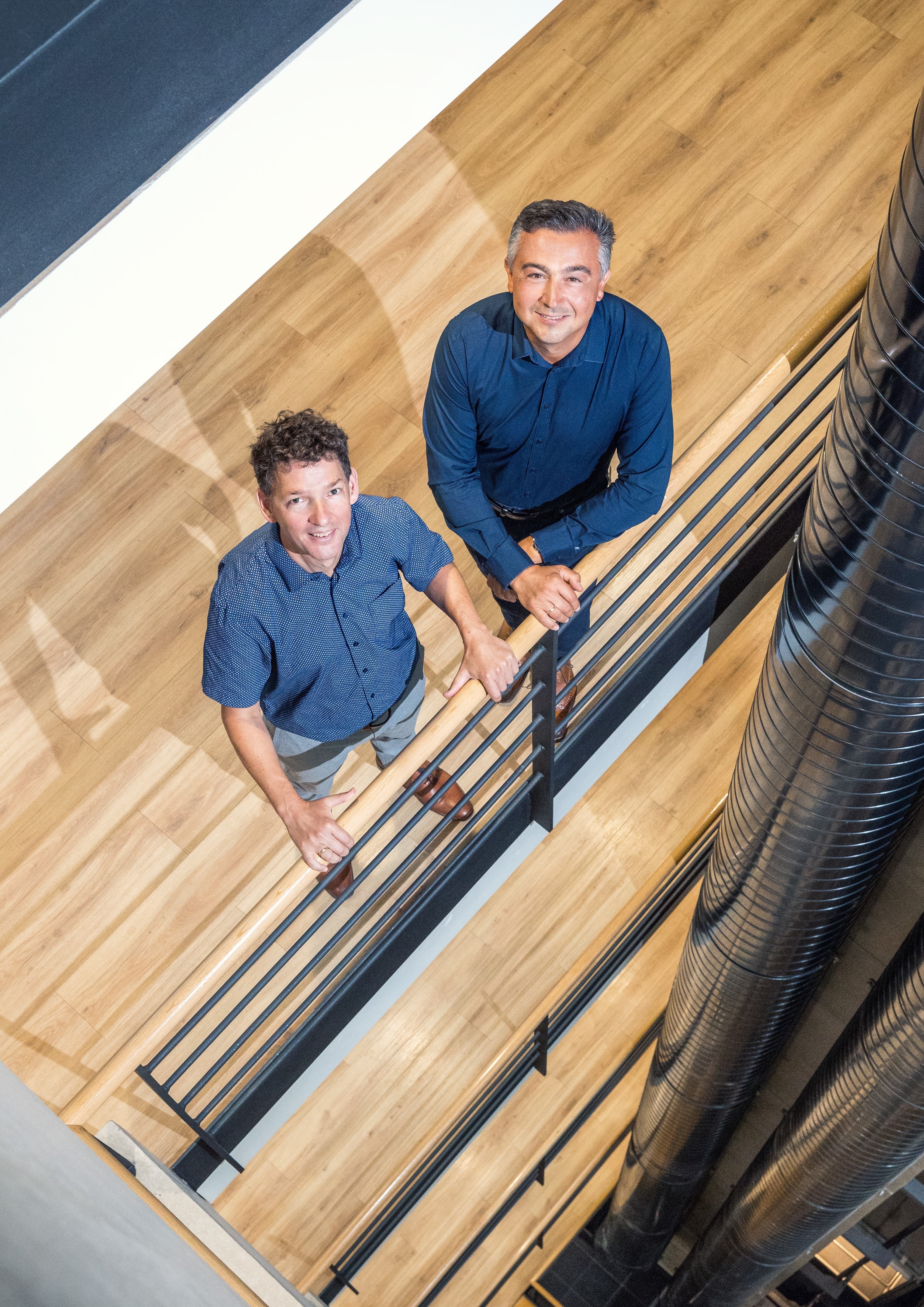
Arie van Deursen and Alan Hanjalic in the Computer Science building

At TU Delft, computer science is organized into two departments: Intelligent Systems, chaired by Alan Hanjalic and Software Technology, chaired by me.

In 2021, Alan and I together worked hard to compile our self-assessment report. It is based on extensive discussions with and contributions by many people, both inside and outside the two departments. It contains our thoughts on what we want computer science in Delft to achieve (our mission), what we did to achieve this (our strategy), an assessment of the success of our approach (our SWOT), and a plan of action for the next years ahead (our future strategy).

We proudly make the full self-assessment report available via this link — the only modification being that for reasons of privacy we omitted some of the appendices that could be traced back too easily to individual faculty members.

As part of the protocol, the committee’s findings, as well as the reaction of the executive board to these findings, have been made available as well, at the central TU Delft site. The committee is “positive about the very high and often excellent research quality, the high quality of the staff as well as the energy, drive and potential of the primarily junior research staff of both departments,” and “recognizes the relevance and societal impact of the researchcarried out the INSY and ST departments.”

We are grateful to the external committee, and in particular for the 17 recommendations that will help us further strengthen TU Delft computer science. We have integrated these recommendations in the action plan already laid out in our self-assessment, and look forward to work with everyone in our departments and our faculty to execute this action plan in the next few years.

Below, we provide the executive summary of our self-assessment, and we invite you to have a look at our full report.


Self-Assessment Summary

The phenomena of datafication and AI-zation reflect the increasing tendency to quantify everything through data and to automate the decision-making processes that are also largely based on data. Since these phenomena have entered all segments of our lives and since research in computer science (CS) is at the heart of the technological developments underlying these phenomena, CS as a research field has gained strategic importance. TU Delft Computer Science operates at the forefront of these developments with the aim to help society at large, by enabling it to maximally benefit from these phenomena, while protecting it from potential risks. To that end, inspired and driven by the TU Delft core values of Diversity, Inclusion, Respect, Engagement, Courage and Trust (DIRECT), our mission includes (1) conducting world class research in selected computer science core areas; (2) maximizing opportunities for societal impact of our research; (3) providing rigorous, research-inspired engineering education in computer science; and (4) contributing to an international academic culture that is open, diverse and inclusive, and that offers openly available knowledge.

We are organized in two departments, Intelligent Systems and Software Technology, consisting of 5 and 6 sections respectively. Sections are small-scale organizational units, typically headed by a full or associate professor and marking a particular CS disciplinary scope. While the departments are separate units, they work closely together in research and education, and collaborate for societal impact. The convergence between the departments in terms of alignment and joint pursuit of strategic and operational goals has even become so strong over recent years that we can speak of an increasingly recognizable CS entity in Delft organizing its research into five main themes transcending the departmental and section boundaries: (1) decision support; (2) data management and analytics; (3) software systems engineering; (4) networked and distributed systems; and (5) security and privacy. The themes offer critical mass in order to achieve substantial impact, and each theme involves many researchers with various CS backgrounds and expertise.

Award-winning research in these themes achieved during 2015-2020 include a novel cross-modal (e.g., combining text and images) retrieval method based on adverserial learning; genetic algorithms for the automatic reproduction of software crashes to facilitate automated debugging; and Trustchain, a permission-less tamper-proof data structure for storing transaction records of agents with applications in digital identity. International recognition of our expertise is reflected by numerous leadership roles, e.g., as general or program chairs in numerous flagship conferences, such as AAAI, EuroGraphics, ACM/IEEE ICSE, ACM OOPSLA, ACM RecSys and ACM Multimedia. In the same time period, several staff members also received the highest (inter)national recognition in their fields, such as IEEE Fellow, membership of the Young Academy of the Royal Dutch Academy of Sciences, or the Netherlands Prize for ICT Research. Our scientific reputation also brought us into the consortia of two prestigious NWO Gravitation Projects (“NWO Zwaartekracht“) of the Dutch Research Council, Hybrid Intelligence and BRAINSCAPES – the consortia that “belong to the world top in their field of research or have the potential to do so”

To maximize societal impact, we embrace eight key sectors: transport and logistics, energy, health and well-being, safety and security, finance, online education, creative industry, and smart cities. To enable and support us in making substantial interdisciplinary impact in these sectors, we have built up expertise, a network of collaborators and societal partners, and established the necessary organizational structures. Prominent examples of our impact in these sectors include the NGS sequencing analysis pipeline we designed and implemented as part of the NIPT test, which is used routinely by hospitals in several countries; Cytosplore, a software system for interactive visual single-cell profiling of the immune system; and SocialGlass, a tool suite for integration, enrichment, and sense-making of urban data. Our close ties with society are also reflected in our strategic collaborations with socio-economical partners, such as ING, DSM, Booking.com, Adyen, Ripple, Erasmus Medical Center and Leiden University Medical Center, leading amongst other things to strategic investments in the form of three large industry-funded labs (with ING, DSM and Booking.com) setup in the assessed time period for a duration of five years. Furthermore, we have invested extensive effort in public outreach, explaining and discussing science with a broad audience, and in particular in the context of complex societal debates in the domain of AI and blockchain. Finally, we play a leading role in regional, national and European initiatives, most notably in the Dutch AI Coalition (NLAIC).

In addition to scientific excellence and strong impact in the selected societal sectors, we are committed to (a) meeting the increasing societal need for highly skilled CS experts, (b) development of human capital in our organization, leading to a new generation of international academic leaders, and (c) advancing the organization and academic culture, with the key pillars of open science, diversity and inclusion.

Regarding (a), we embraced an over 100% increase of our student population, but also aim at securing the highest possible level of their knowledge, skills and academic forming despite scaling up. Therefore, we value a close connection between research and education, and let both MSc and BSc students participate actively in our research. We also formulated an ambitious strategy, the realization of which would enable us to manage this education scale-up efficiently and effectively, leaving sufficient room to our staff for further developing scientific excellence and deploying it for societal impact. Part of this strategy is the growth of our academic staff towards 100 FTE by 2024 to meet the stabilization of the student numbers (due to numerus fixus). Between 2015 and 2020, we already achieved a net growth from 54 to 72 faculty members (+33%), with more to come in the upcoming years.

Next to BSc and MSc students, we are committed to delivering highly skilled CS experts at the PhD level. The number of PhD students grew from 105 to 165 (+57%) in the assessed time period, reflecting our ability to successfully acquire research funding in the present landscape. For our PhD students, the Graduate School defines a framework in which they can develop their skills next to conducting their thesis research. We strive towards completion of PhD theses within four years and organize our supervision, official moments of assessment, requirements on the volume and quality of the conducted research, as well as evidence of scientific impact through publications, accordingly.

Regarding (b), development of human capital: as computer science expertise is in high demand across the globe, finding strong new people as well as retaining our current staff proved highly challenging, especially given the high teaching load due to our record student intake. Therefore, acquiring, developing and retaining academic talent has been one of our most important goals. Dedicated actions, such as devising of a Development Track Plan, serve to empower each staff member to provide contribution to the organization in his/her own way, based on individual interests, talents and ambitions, and in view of our joint ambition as organization.

In view of (c), our organization, we embrace open science, with a substantial percentage (80% in 2020) of our articles available as open access, and by making numerous software tools and data sets openly available. We are a highly international organization with employees and students from all over the world. We strive to be an inclusive organization, where staff and students feel at home and valued, regardless of their background, age, gender, sexual orientation or functional disability. In terms of female faculty, we realized a net growth from 11 to 14 faculty members. As the number of men employed also increased, the percentage of female faculty stayed stable at around 20%. We consider this too low. We are committed to addressing this, for which we will take a long-term approach with, amongst other means, dedicated budget reserved for continued openings for female faculty in the upcoming years.

We are proud of our scientific successes and societal impact in the core computer science disciplines as well as in interdisciplinary research in our target societal sectors. This is especially so as those were achieved in a period that was transformational for TU Delft Computer Science, characterized by substantial growth and development across our organization and activities. We anticipate an even stronger societal demand for our research and expertise in the future. We will therefore continue to initiate, participate and take on a key role in effective and interdisciplinary partnerships at the university (TU Delft AI), regional (LDE), national (ICAI, IPN), and European (ELLIS, CLAIRE) levels. Furthermore, we will continue the growth path for our staff, in order to build up capacity enabling us to further develop our scientific excellence and offer our strongly increased student population the world-class research-intensive education they deserve. To achieve this, we center the next steps in our ongoing transformation around people, organization, and profiling and identify seven key actions for the upcoming years that aim at (1) improving our attractiveness as an employer; (2) improving diversity and inclusion; (3) improving the execution of the PhD program; (4) expanding our staff capacity; (5) aligning our office space with the optimal way of working; (6) articulating the scientific profile; and (7) boosting our scientific and societal impact.

Eelco Visser (1966-2022)

Text of the eulogy for Eelco Visser (12 October 1966 – 5 April 2022) at his farewell ceremony held in Leusden, April 2022. Original text in Dutch.

December 2017

I stand in front of you, in total disbelief, as head of the department for which Eelco Visser has worked the last 15 years.

I would like to offer you my perspective on Eelco’s significance, as a scientist, as a teacher, and as a person.

Eelco and I got to know each other in 1992, thirty years ago.

At the time, I was halfway my PhD in Amsterdam, working in the group of Paul Klint. Eelco was studying in Amsterdam, following Paul’s courses. These were so inspiring to Eelco that he decided to join Paul’s group, first to write his master’s thesis, and then to work on his PhD.

It didn’t take long before Eelco and I had a connection. We had extensive discussions about research. The details don’t matter, and they didn’t really lead to concrete results. But thirty years later I still remember the substantive drive, the deep desire to profoundly understand a problem, the feeling to work on something very important, and, of course, Eelco’s tenacity.

Eelco has been able to maintain that same drive for thirty years. Just like he knew how to inspire me, year after year he has inspired his students and his (international) peers — always driven by content, always persistent.

This contributed to Eelco’s research being of the highest international level. Let me illustrate this through an award he received in 2020, a so-called Most Influential Paper award. This is an award you get ten years after publication, after it has been established that your paper actually had made the biggest impact.

Eelco received this award for his article from 2010 on Spoofax, written with (then) PhD student Lennart Kats. Eelco was very proud of this award, and rightly so. In fact, he was so proud that he wrote a (long) blog post about it, entitled “A short history of the Spoofax language workbench.”

This “short history” starts in 1993 with Eelco’s PhD research in Amsterdam. Next, Eelco explains his journey, from Portland as a postdoc, via Utrecht as assistant professor, to Delft as associate and full professor. Each of these stops provides building blocks for the award-winning paper from 2010. And then, Eelco’s “short history” continues: He describes what his group in those ten years after the paper’s publication has done, and what good things he still has in store for the time to come.

To me, this “short history” is signature Eelco:

  • Visionary, working year after year on building blocks that all belong together
  • System-driven, with working software that he preferably contributes to himself
  • In a team, together with his PhD students, postdocs, engineers, students, and numerous international co-workers.

This short history also serves to illustrate the international side of Eelco’s work. He was very active, and loved, within international organizations like IFIP and ACM SIGPLAN. He succeeded in bringing the flagship SPLASH conference to Europe for the first time.

And, naturally, Eelco had a vision on how to improve things: All those conferences putting effort in ad hoc web sites: There had to be a better way. And so, in line with his systems philosophy, he designed the CONF system that has been up and running for ten years now. And he managed to convince hundreds of conferences to use his system, for a fee.

Likewise, Eelco had a vision on education, and he knew how to realize it. In his opinion, programming education just had to be better. Thus, he designed a system, WebLab, which has also been in operation for almost 10 years now. And here too he managed to convince countless teachers to use his system.

In addition, Eelco had a well-thought-out opinion about the courses that belong in a computer science program. So when we needed to revise our curriculum, Eelco was the perfect candidate to chair the associated committee. Eelco did this graciously, in a calm and persistent manner, reasoning from educational principles to settle disputes. The result is rock solid.

Eelco’s education is well characterized by Willem-Paul Brinkman in the online Farewell Community: Without maybe realizing it, many generations of Delft students will benefit from his teaching innovations.

Eelco was proud of his Programming Languages Group. He built it up from scratch into an international top group. He took good care of his people, fighting for the best equipment and offices. As a member of the departmental management team, he fought for computer science in full, at faculty and university level. Nationally he was active in, for example, the Dutch National Association for Software Engineering VERSEN.

And how was Eelco able to realize all this? What was his secret?

Perhaps Eelco actually liked (a little) resistance. He was not afraid to disagree: after all, he had thought deeply about his opinion. And he was fine with being challenged: it was a sign that he was well on his way to breaking the status quo.

Maybe not everyone always found this easy. But Eelco was also very friendly, and certainly willing to change his mind.

And, Eelco was also patient: Big changes take time. If he saw that he had insufficient supporters, he could wait. Or, under the radar, start small in order to set his own plans in motion.

How much we will miss Eelco in Delft! The visionary, the obstinate, the focus on the content, the love for computer science, the tenacity, and the attention for students and colleagues: exactly what we need so much in Delft.

Let me conclude with a few words related to Corona and the lock down. The past few years, Eelco and I were in touch weekly, mostly within the departmental management team, but also often one-on-one. All online, from home. We discussed departmental matters, small and large, as well as the impact of Corona. On one thing we agreed: Being at home more, seeing more of your children, doing more with the family: we both experienced this as a gift.

Due to the lock down, I don’t know when it was that I saw Eelco last in person. I think it was on October 14, at the PhD defense of Arjen Rouvoet. This was a beautiful day, and this is how I like to remember Eelco: Science at the highest level, international peers in substantive debate, a cum laude PhD defense, and Eelco happy, radiant in the midst of his PL group.

Dear family, friends, colleagues, everyone: We will miss Eelco very much. Each of us has his or her own, wonderful memories of Eelco. Today is a day to hold on to that, and to share those memories with each other.

I wish you all, and especially the family, all the best.

Eelco Visser (1966-2022)

Toespraak gehouden tijdens de uitvaartplechtigheid van Eelco Visser (12 oktober 1966 – 5 april 2022) op 12 april 2022 in Leusden. English translation available.

December 2017

Ik sta hier, in totale verbijstering, als hoofd van de afdeling waar Eelco Visser de afgelopen 15 jaar gewerkt heeft.

Ik wil U graag iets vertellen over de betekenis van Eelco, als wetenschapper, als docent, en als mens.

Eelco en ik leerden elkaar kennen in 1992, dertig jaar geleden.

Ik was toen halverwege mijn promotie in Amsterdam, en werkte in de groep van Paul Klint. Eelco studeerde toen in Amsterdam, en volgde colleges bij Paul. Die inspireerden hem zo dat hij zich aansloot bij Pauls groep om daar eerst af te studeren en later te promoveren.

Eelco en ik hadden al snel een klik. We hadden uitgebreide discussies over onderzoek. De details doen er niet toe, en tot een echt resultaat hebben ze niet geleid. Maar dertig jaar later herinner ik me nog steeds de inhoudelijke drive, de wens om een probleem écht te snappen, het gevoel samen met iets héél belangrijks bezig te zijn, en natuurlijk Eelco’s vasthoudendheid.

Diezelfde drive heeft Eelco dertig jaar vast weten te houden. Zoals hij mij wist te inspireren, heeft hij jaar in jaar uit zijn studenten, zijn promovendi, en zijn internationale collega’s aan zich weten te binden — altijd vanuit de inhoud, en altijd vasthoudend.

Mede hierdoor was Eelco’s onderzoek van het hoogste internationale niveau. Laat ik dit illustreren aan de hand van een prijs die hij in 2020 ontving: een zogenaamde “Most Influential Paper” Award. Zo’n prijs krijg je pas als je artikel 10 jaar na publicatie de meeste invloed gehad bleek te hebben.

Eelco kreeg die voor zijn artikel uit 2010 over Spoofax, met promovendus Lennart Kats. Eelco was hier, terecht, heel trots op. Zó trots, dat hij er een (lange) blog post over heeft geschreven, getiteld Een korte geschiedenis van de Spoofax taalwerkbank.

Deze “korte geschiedenis” begint in 1993 bij Eelco’s promotieonderzoek in Amsterdam. Vervolgens legt Eelco zijn reis uit, van Portland als postdoc, via Utrecht als universitair docent, naar Delft als hoofddocent en hoogleraar. Elk van deze tussenstops levert bouwstenen op voor het winnende paper uit 2010. En vervolgens gaat Eelco’s “korte geschiedenis” door: Hij beschrijft wat zijn groep in die tien jaar na het paper heeft gedaan, en wat voor moois hij nog in petto heeft voor de tijd die komen gaat.

Wat mij betreft is deze “korte geschiedenis” Eelco ten voeten uit:

  • visionair, jaar in jaar uit werkend aan bouwstenen die allemaal bij elkaar horen
  • systeem-gedreven, met werkende software systemen waar hij het liefst zelf aan meeprogrammeert
  • in team verband, samen met zijn promovendi, postdocs, engineers, studenten, en talloze internationale collega’s.

Deze korte geschiedenis laat ook iets zien over de internationale dimensie van Eelco’s werk. Hij was zeer actief, en geliefd, binnen internationale organisaties zoals IFIP en ACM SIGPLAN. Het lukte hem om het top-congres SPLASH voor het eerst naar Europa te halen.

En natuurlijk had Eelco een visie hoe het beter kon: Al die congressen die hun web site in elkaar liepen te knutselen: dat moest efficiënter kunnen. En dus, in lijn met zijn systeem-filosofie, ontwierp hij het CONF systeem dat nu al tien jaar in de lucht is. En wist hij honderden congressen te overtuigen zijn systeem, tegen betaling, te gebruiken.

Ook op het gebied van onderwijs had Eelco een visie, en wist hij die te realiseren. Programmeeronderwijs moest beter, vond hij, en dus ontwierp hij een systeem, WebLab, dat nu ook al bijna 10 jaar in de lucht is. En ook hier wist hij talloze docenten te overtuigen zijn systeem te gebruiken.

Daarnaast had Eelco een goed doordachte mening over welke vakken in een opleiding informatica thuis horen. Toen wij ons curriculum moesten herzien, was Eelco de perfecte kandidaat om de bijbehorende commissie voor te zitten. Eelco deed dit met verve, rustig en vasthoudend, redenerend vanuit onderwijskundige principes om geschillen te beslechten. Het resultaat staat als een huis.

Voor Eelco’s onderwijs geldt wat Willem-Paul Brinkman in het online condoleance register schreef: “Zonder het misschien te beseffen, zullen vele generaties Delftse studenten profiteren van zijn onderwijsinnovaties.”

Eelco was trots op zijn “Programming Languages Group“. Hij heeft die uit het niets opgebouwd tot een internationale topgroep. Hij zorgde goed voor zijn mensen, en streed voor de beste apparatuur en werkplekken. Als lid van het management team van de afdeling, zette hij zich in voor informatica in de volle breedte, op facultair en universitair niveau. Ook landelijk was hij actief, onder meer in de Nederlandse Vereniging voor Software Engineering VERSEN.

En hoe kreeg Eelco dit allemaal voor elkaar? Wat was zijn geheim?

Misschien vond Eelco (een beetje) weerstand eigenlijk wel leuk. Hij was niet bang tegengas te geven: hij had tenslotte goed nagedacht over zijn mening. En hij vond het prima tegenstand te krijgen: dat was een teken dat hij goed op weg was de status quo te doorbreken.

Misschien vond niet iedereen dit altijd even makkelijk. Maar Eelco was ook heel vriendelijk, en zeker bereid van mening te veranderen.

En, Eelco was ook geduldig: Grootse veranderingen kosten tijd. Als hij zag dat hij onvoldoende medestanders had kon hij wachten. Of, onder de radar, alvast klein beginnen om zijn eigen plannen toch in gang te zetten.

Wat zullen we Eelco missen in Delft. Het visionaire, het dwarse, de focus op de inhoud, de liefde voor het vak, de vasthoudendheid, en de aandacht voor student en collega: juist dat hebben we nodig in Delft.

Ik wil afsluiten met een paar woorden naar aanleiding van Corona en de lockdown. De afgelopen twee jaar hadden Eelco en ik wekelijks contact, vooral binnen het management team van de afdeling, maar ook vaak 1-op-1, allemaal online, vanuit huis. We bespraken het reilen en zeilen van de afdeling, en de impact van Corona. Over één ding waren we het eens: Meer thuis zijn, meer zien van je kinderen, meer doen met het gezin: dit hebben we allebei als een geschenk ervaren.

Door de lockdown weet ik niet wanneer ik Eelco voor het laatst echt gezien heb. Ik denk dat het 14 oktober was, bij de promotie van Arjen Rouvoet. Dat was een mooie dag, en zo herinner ik me Eelco graag: Wetenschap van het hoogste niveau, internationale collega’s in inhoudelijk debat, een cum laude promotie, en Eelco gelukkig, stralend temidden van zijn PL groep.

Lieve familie, vrienden, collega’s, allemaal: We zullen Eelco zéér missen. Iedereen van ons heeft zijn of haar eigen, prachtige herinneringen aan Eelco. Vandaag is een dag om daaraan vast te houden, en om die herinneringen met elkaar te delen.

Ik wens u allen, en in het bijzonder de familie, alle sterkte toe.